Loading…
All models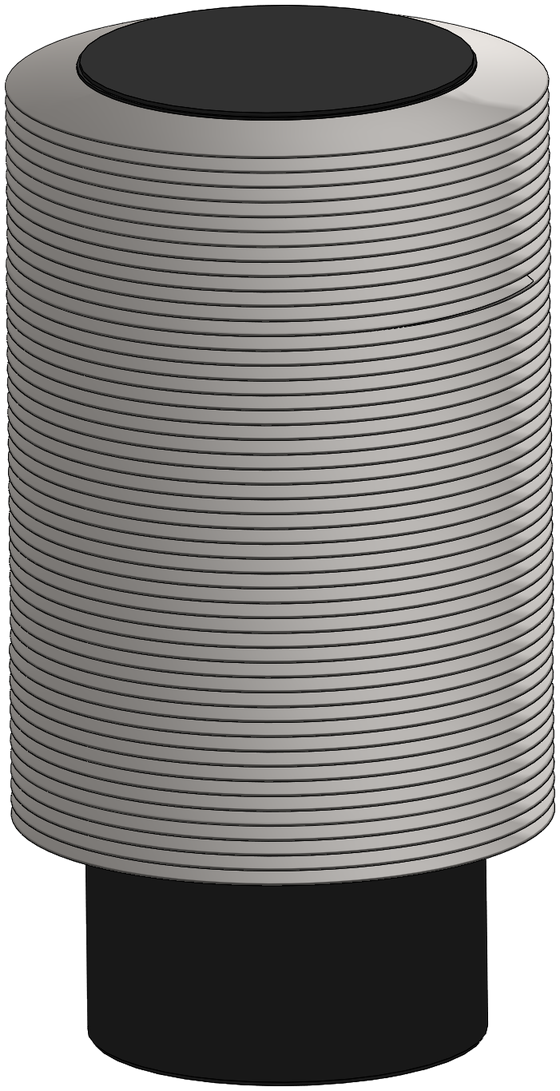
Product family · Higher output
DAWT 450W
450WNameplate power
Modeled
The higher-output configuration, aimed at communications sites, multi-device installations, and compounds carrying a larger battery system than a single instrument cluster needs.
Engineering concept model · shown at relative scale
Preliminary specification
| Nameplate power | 450 W |
|---|---|
| Designation | DAWT 450W |
| Modeled generation @ 5 m/s avg wind | 746 Wh/day |
| Equivalent average continuous | 31.1 W |
| Modeled output @ 10 m/s (22 mph) | 131 W |
| Rated condition | 15 m/s (34 mph) |
| Cut-in wind speed | 2.2 m/s (5 mph) |
| Family position | Higher output |
| Application class | Higher-power remote loads and larger battery systems |
| Battery compatibility | Optional — AGM, LiFePO₄, gel, or an existing bank |
| Mounting options | Available during pilot configuration |
| Environmental configuration | Configuration dependent |
Preliminary engineering configuration. Modeled generation derives from CFD report TR-26-0019; nameplate ratings and output figures remain subject to validation through wind-tunnel and field testing. Physical dimensions, weights, generator specifications, cut-out and survival wind ratings, and certification status are not final and are not published.
Modeled power estimate
Modeled performance — DAWT 450W
Modeled performanceAverage output across 24 hours, against the site's average wind speed. Hover the chart to read any site.
A site that averages 5 m/s does not blow at 5 m/s — it varies. Because power follows the cube of wind speed, the windier hours contribute far more than the calm ones take away, so the day average sits well above what an unvarying breeze at the same speed would produce.
Approved performance points — DAWT 450W
Energy · Wh/day
746 Wh/day
At a 5 m/s average wind, over 24 hours — 31.1 W equivalent average.
Average · W
31.1 W
Averaged over 24 hours at a 5 m/s average site.
Power · W
450 W
Nameplate, at the 15 m/s (34 mph) rated condition.
Watts (W) are power at a moment. Watt-hours per day (Wh/day) are energy accumulated over 24 hours. A DAWT 300W is a 300 W nameplate machine that is modeled to generate 498 Wh over a day at a 5 m/s average wind — the two numbers describe different things.
Modeled performance, not measured results. Output is derived from the aerodynamic performance measured in CFD report TR-26-0019 (September 2026), applied at sea-level air density with an assumed 80% generator and charging efficiency. Power follows the cube of wind speed, so doubling the wind is roughly eight times the power, and output reaches nameplate near 15 m/s (34 mph). Daily and average figures are evaluated across a Rayleigh wind speed distribution at a 5 m/s (11 mph) annual mean — below the lowest standard small-wind class in IEC 61400-2, which sets Class IV at 6 m/s — on the distribution basis IEC 61400-2 and AWEA 9.1 specify. These are modelled design-basis figures pending wind-tunnel validation; they are not field-validated, certified, or measured production numbers.
At a 5 m/s average wind condition, the DAWT 450W is modeled to generate 746 Wh over 24 hours — about 31.1 W of equivalent average continuous generation. At 10 m/s (22 mph) the modeled instantaneous output is 131 W, reaching its 450 W nameplate at the 15 m/s (34 mph) rated condition. Modeled performance, pending validation testing.
Complete system
The DAWT 450W Kit.
Most sites buy the turbine as part of a complete remote power kit — generation, power management, storage, and protected output specified together rather than assembled on site.
DAWT 450W Remote Power Kit · engineering concept
- 746 Wh/day
- Modeled generation at 5 m/s average wind
- 12–15 W
- Continuous load budget
- 24 V DC
- System voltage
- 300 W panel
- Optional solar
Battery options
Storage is a choice, not a fixed part of the kit. Charge profiles and disconnect thresholds are set for whichever chemistry the site wants.
LiFePO₄AGMGelExisting bank
What ships with it
- Generation
- Control and conversion
- Storage
- Mounting and structure
- Commissioning and monitoring